
Uranium market

Sentiment towards nuclear energy has shifted decisively since 2018. Nuclear is now widely recognised as an essential component of any credible decarbonisation strategy. In an era of volatile fossil fuel markets and escalating geopolitical risk, its capacity to deliver sovereign, long-duration power with limited exposure to import dependence and supply-chain disruption has strengthened its role as a strategic asset as much as an energy source. Global uranium supply, meanwhile, remains concentrated, and the length of the nuclear fuel value chain means supply responds slowly to changes in demand.
Key demand and supply side drivers
Demand side drivers
Supply side constraints
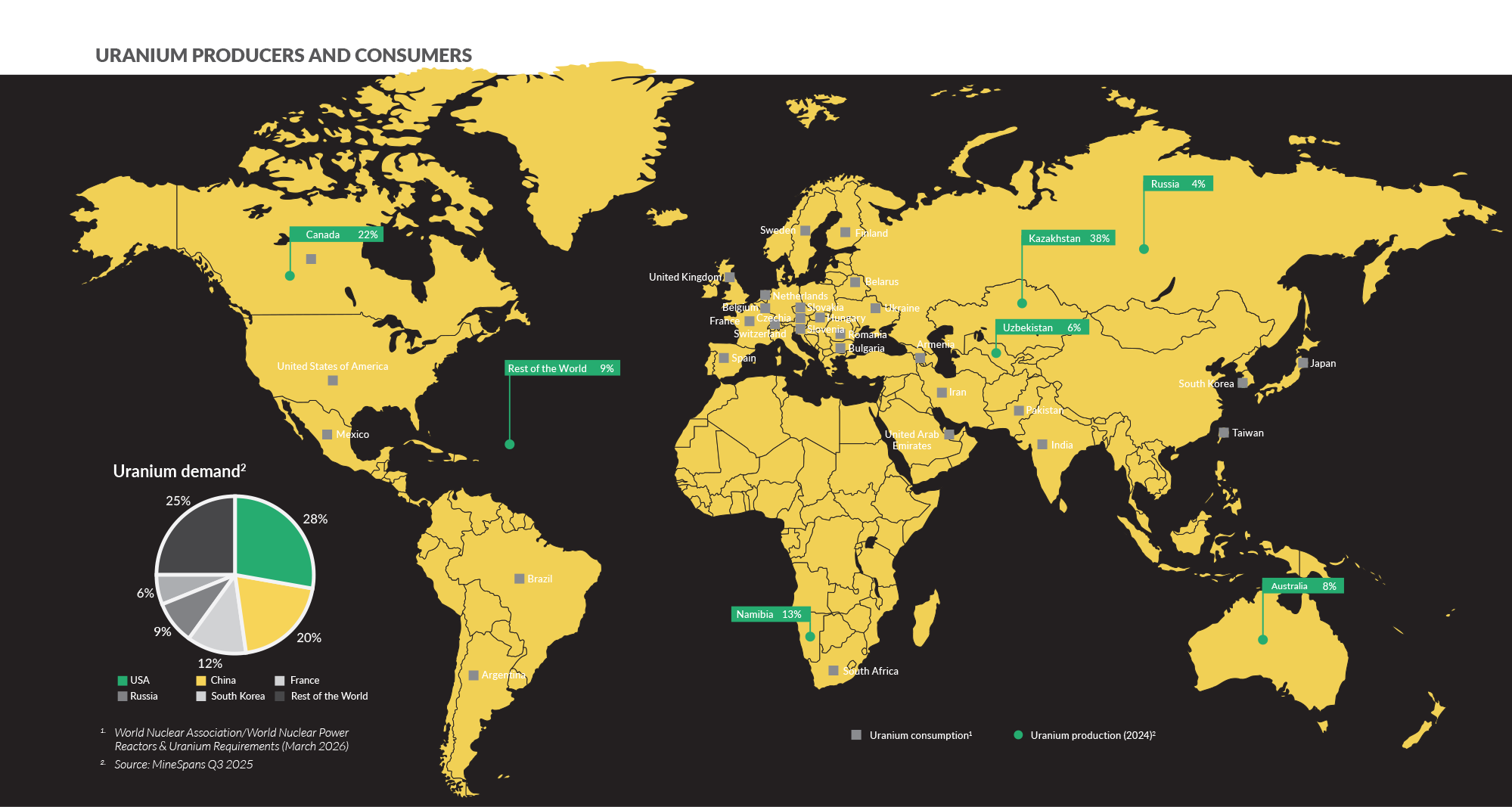
The front end of the nuclear fuel cycle covers uranium’s journey from mine to reactor. It is a complex process that can take as long as 18 months.*OECD – NEA, The Economics of the Nuclear Fuel cycle (1994) Uranium production, conversion, enrichment and fabrication is concentrated in relatively few locations, while demand for uranium is spread across 31 countries where 438 reactors are currently operable with a combined capacity of approximately 401 GWe, generating around 9% of global electricity and over 20% of the world’s clean electricity.*World Nuclear Association/World Nuclear Power Reactors & Uranium Requirements (March 2026)

Mining

Uranium is mined using in-situ leaching, open pit and underground mining.

Uranium ore is processed to produce uranium oxide concentrate U3O8.

Conversion

Conversion plants convert physical U3O8 from powder form into natural uranium hexafluoride gas (UF6).

Enrichment

Gaseous uranium (UF6) is enriched, raising the uranium-235 isotope from the natural level of 0.7% to the range of 3.5% to 5% required for use in nuclear reactors.

Fuel fabrication

Enriched UF6 is converted to uranium dioxide powder which is fabricated into fuel rods and then fuel rod bundles. Fuel rod bundles are placed into nuclear reactors owned by utility companies.

Power generation

Heat from nuclear fission produces steam that drives turbines to generate electricity.
  • Uranium enrichment is a sensitive technology from a nuclear non-proliferation standpoint and is tightly controlled. Almost all of the world’s conversion and enrichment capacity is concentrated in China, France, Canada, Russia, the
United Kingdom and the United States.*World Nuclear Association, Nuclear Fuel Cycle, Uranium Enrichment Russia accounts for approximately 45% of global enrichment capacity, which creates challenges for Western fuel security.
  • Typically, nuclear power utilities refuel on average around every 18 months*World Nuclear Association, Nuclear Fuel Cycle Overview, holding uranium inventories as working inventory (being enriched, or fabricated into fuel) or strategic inventory (forward requirements held in the event of 
supply disruption).
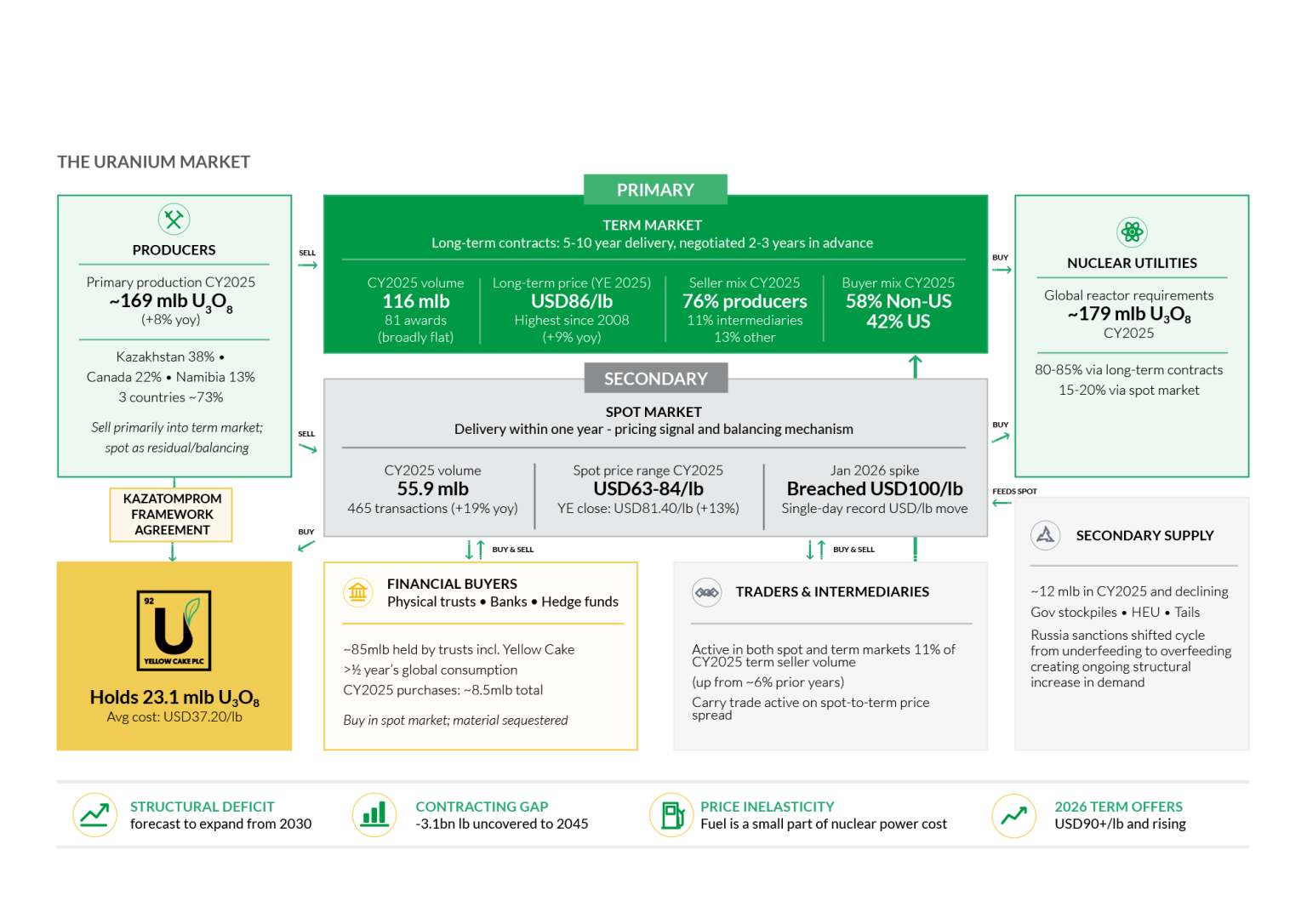
  • Utilities generally seek to secure most of their uranium requirements directly with producers, converters and enrichers (two to three years in advance and for at least five years of deliveries). Typically around 80% to 85% of utilities’ uranium requirements are secured through these long-term contracts.
  • The balance of their uranium requirements is purchased in the spot market (defined as delivery within a year) which generally trades at a discount to the term contract prices.
Uranium markets structure

Refer to the Our strategy section of the 2026 Annual Report for more information and source references. 

  1. Nuclear energy remains a key and growing element of global energy supply on the path to net zero Almost all the world’s uranium production is used to produce electricity in nuclear power plants. The International Energy Agency projects that global electricity demand will increase by around 40% to 2035, growing six times faster than overall energy demand, driven by electrification of industrial processes, transport, heating, cooling and the data infrastructure that powers artificial intelligence.*IEA, World Energy Outlook 2025; IEA, The Path to a New Era for Nuclear Energy, 2025

    The energy sector accounts for more than three quarters of global greenhouse gas emissions.*IEA, Greenhouse Gas Emissions from Data Explorer Interest in nuclear energy is currently at its highest level since the oil crises of the 1970s, according to the IEA. Its Net-Zero Emissions Scenario projects nuclear power generation more than doubling to approximately 1,079 GWe by 2050, requiring an average of 22 GW of new capacity to be added each year. This implies a significant ramp up in investment in nuclear production when compared to a net addition of just 4.3 GW in 2024.*World Nuclear Industry Status Report, “Fewer countries building new reactors”, 21 January 2025
  2. National energy policy is shifting in favour of nuclear in some of the biggest consumers of uranium The recent change in sentiment towards nuclear has created a more positive national and regional policy outlook, particularly in North America, China and Europe. 39 countries have now committed to at least tripling nuclear capacity by 2050, with China, Brazil, Italy, Belgium and South Africa joining the Declaration to Triple Nuclear Energy during 2026. The World Nuclear Association projects total global capacity could reach 1,446 GWe by 2050, surpassing the approximately 1,200 GWe target set under the Declaration at COP28 in 2023. A more detailed analysis can be found in our 2026 Annual Report.
  3. Power utility long-term contracts need to be replaced Typically, around 80% to 85% of utilities’ uranium requirements are covered by long-term contracts. Total long-term contracting held steady at approximately 116.2 million lb in calendar 2025, broadly flat on 2024 and well below global reactor requirements of approximately 179 million lb.*UxC Weekly, 2025 Uranium Term Contracting Review, 9 February 2026 While non-US utility volume declined for a third consecutive year in 2025, US utilities increased term purchases by 56% year on year. Coverage rates remain well short of forward requirements.*US Energy Information Administration Uranium Marketing Annual Report 2024 (September 2025); Euratom Supply Agency Annual Report 2024 (September 2025) UxC estimates that approximately 3.1 billion lb of utility requirements through 2045 remain uncovered by existing contracts, and utilities will have to cover the shortfall in the context of constrained uranium production, declining secondary supplies and a tighter spot market.
  4. Declining secondary supply  Secondary supplies at their peak represented approximately 33% of total uranium demand but have declined steadily to approximately 12 million lb in calendar 2025, and are projected to fall to around 6% to 7% of demand over the coming decade.*MineSpans Q3 2025 A significant quantity of U3O8 has been taken off the market by strategic stockpiling by China and India, as well as sequestering by financial entities. Physical uranium holders, which include Yellow Cake and the Sprott Physical Uranium Trust, currently hold approximately 85 million lb of U3O8, equivalent to approximately half of global reactors’ annual requirements.*Sprott Asset Management LP, “Daily and Cumulative Pounds of Uranium (U3O8) Acquired by Trust”, Sprott Physical Uranium Trust 7 November 2025; Yellow Cake, April 2026.
  5. The impact of Russia’s invasion of Ukraine on the nuclear fuel cycle Russia’s war with Ukraine highlighted the dependency of major Western nuclear utilities on Russian nuclear fuel. While Russia has 8% of the world’s uranium resources and contributes around 5% to global uranium production, it plays a much larger role in the rest of the nuclear fuel cycle with 20% of global conversion capacity utilised and approximately 45% of all enrichment capacity.*MineSpans (Q3 2025) Governments have started taking steps to incentivise new capacity in the nuclear fuel value chain, but most of these will take at least three to five years to reach scale.
  6. Restrictions on nuclear fuel Sanctions imposed by Western countries on Russia since the start of the war include restrictions and bans on entities and individuals, trade in certain goods and services and freezing of foreign assets. Countries and western utilities took steps to reduce exposure to Russia. In May 2024, President Biden signed into law the Prohibiting Russian Uranium Imports Act, which bans imports of Russian uranium imports into the US from August 2024 to December 2040, although with certain waivers until 2027. In November 2024, the Russian government passed a decree restricting the export of low-enriched uranium to the US.*World Nuclear News, “Russia places ‘tit-for-tat’ ban on US uranium exports”, 18 November 2024

    In January 2026 the European Commission indicated that it is preparing to ban Russian-sourced nuclear fuel as part of its policy to eliminate Russian energy imports into the EU market.* Ukrainian National News, “EU Prepares ban on Russian nuclear products – European Commission”, 27 January 2026.

    Western governments have responded with a coordinated programme of fuel-chain investment. In early 2026 the US Department of Energy awarded approximately USD2.7 billion to domestic enrichment and advanced fuel companies, comprising USD900 million each to Centrus Energy and General Matter for HALEU production capability and USD900 million to Orano for a new LEU facility.*UxC Weekly, “Made in the USA: The New Fuel Security Play”, 19 January 2026 Despite this support, additional commercial enrichment capacity is unlikely to reach the US market at scale before the end of the decade.

    Separately, the Section 232 investigation into imports of processed critical minerals, including uranium, initiated in April 2025, introduced uncertainty into future contracting. In January 2026 the White House published a Presidential Proclamation which, while imposing no tariffs or quotas, directed the US to enter negotiations with trading partners, with remedies including price floors and other trade-restrictive measures under consideration.*The White House, “Adjusting imports of processed critical minerals and their derivative products into the United States”, 14 January 2026 A report-back is expected by mid-July 2026.
  7. Data centres and artificial intelligence create a new demand driver Over the past year there has been a significant acceleration in private-sector commitment to nuclear power as the preferred energy source for data centre infrastructure. The convergence of artificial intelligence workloads, sovereign data requirements and corporate net-zero commitments has created a new class of uranium demand driver. Hyperscale buyers are seeking long-duration, clean, reliable power and may accelerate reactor deployment timelines through creditworthy offtake agreements. The US Department of Energy estimates that data centres consumed approximately 4% of total US electricity in 2023, with projections indicating this could rise to between 7% and 12% by 2028.*US DOE, “DOE releases new report evaluating increase in electricity demand from data centers”, 20 December 2024.
  8. The global reactor fleet and expansion pipeline The nuclear fleet’s growth trajectory has shifted materially in recent years. 201 new reactors representing 194 GWe are already under construction or formally planned.*World Nuclear Association, World Nuclear Power Reactors & Uranium Requirements, March 2026 Up to 16 new reactors are expected to enter commercial operation during 2026 alone, with zero closures currently forecast, which is one of the largest net capacity additions in decades.*UxC Weekly, “Looking forward to 2026”, 5 January 2026 More detail can be found in our 2026 Annual Report.
